Where Ranabi Remains
A visit to Rafikun Nabi's home became a journey through decades of artistic practice, memory, and history…
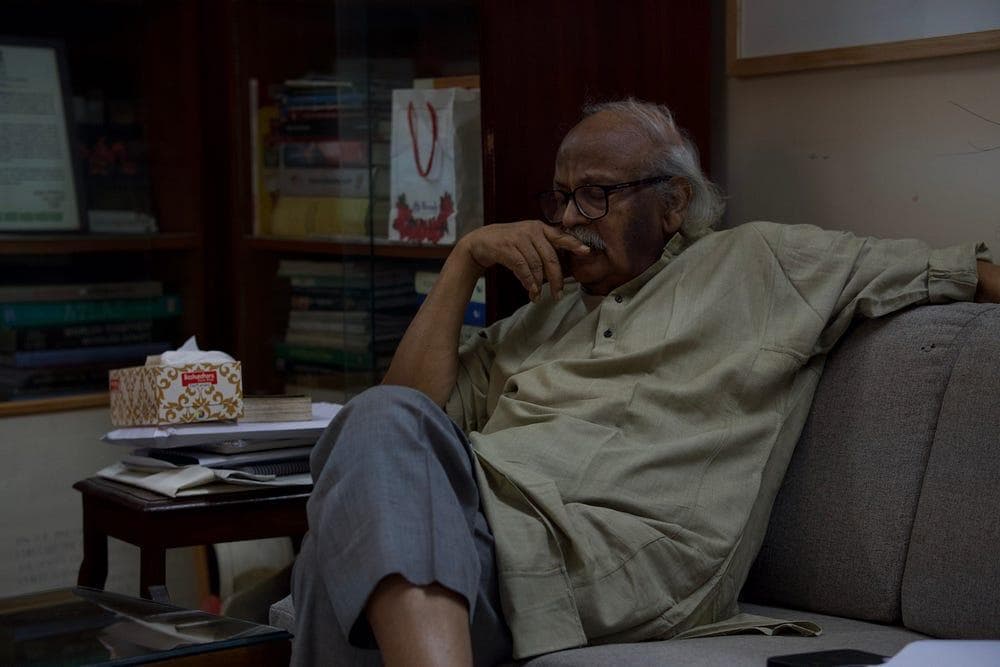
A visit to Rafikun Nabi's home became a journey through decades of artistic practice, memory and history. From paintings created during political upheavals to stories of printmaking, music and creative discipline, the conversation revealed an artist who continues to approach the blank canvas with the same curiosity, humility and sense of wonder that have defined his lifelong practice.
There was a floral arch at the main gate. The moment we crossed it and entered the house, it felt like stepping into a cooler, quieter world — body and mind both settling into calm. Mishu Kaka welcomed us warmly.
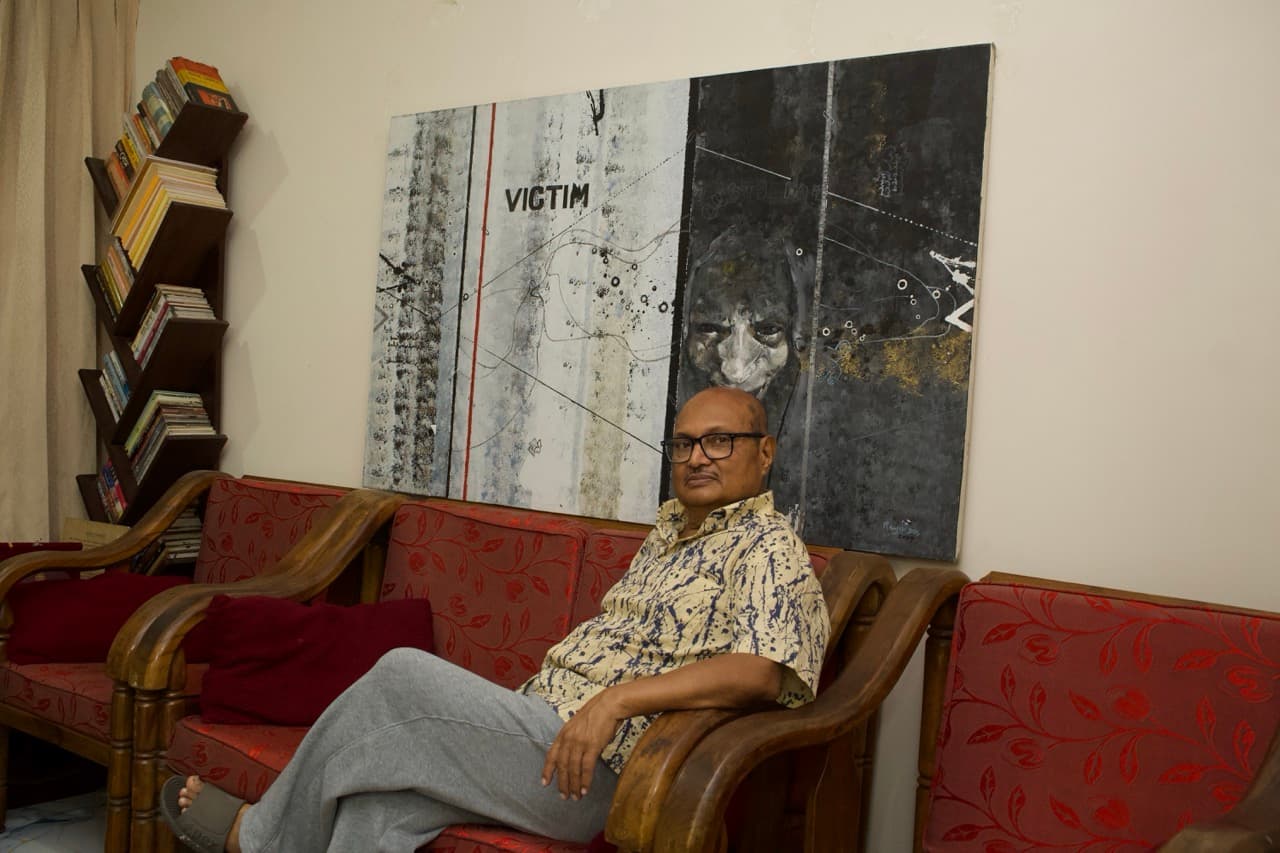
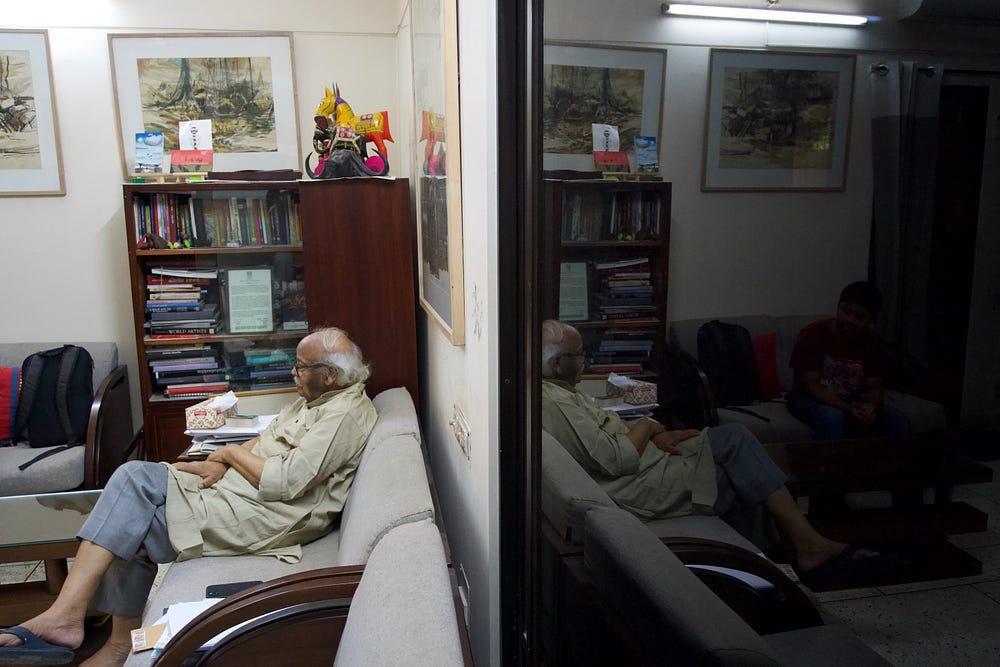
Rafikun Nabi sat quietly in the drawing room, writing a manuscript, with a large painting hanging behind him. Dressed neatly in a panjabi-pajama, surrounded by a calm and still atmosphere, he paused his writing to greet us. There was no exaggeration in his presence, only refinement and simplicity — as though he were practising and contemplating calmness itself. Perhaps “Nisorgo Prem” was never merely a series for him. Through his paintings and his manuscripts, he seemed to keep returning to that same calm.
Painting should come from memory. Only then can the form transform into creativity.
After that, he set his solitude aside and sat with us. “Why senior first?” he asked. “You could have covered younger artists. Why did you come to me?” The answer, perhaps, revealed itself gradually through the visit — the kind of knowledge we were searching for could only have come from someone like Rafikun Nabi.
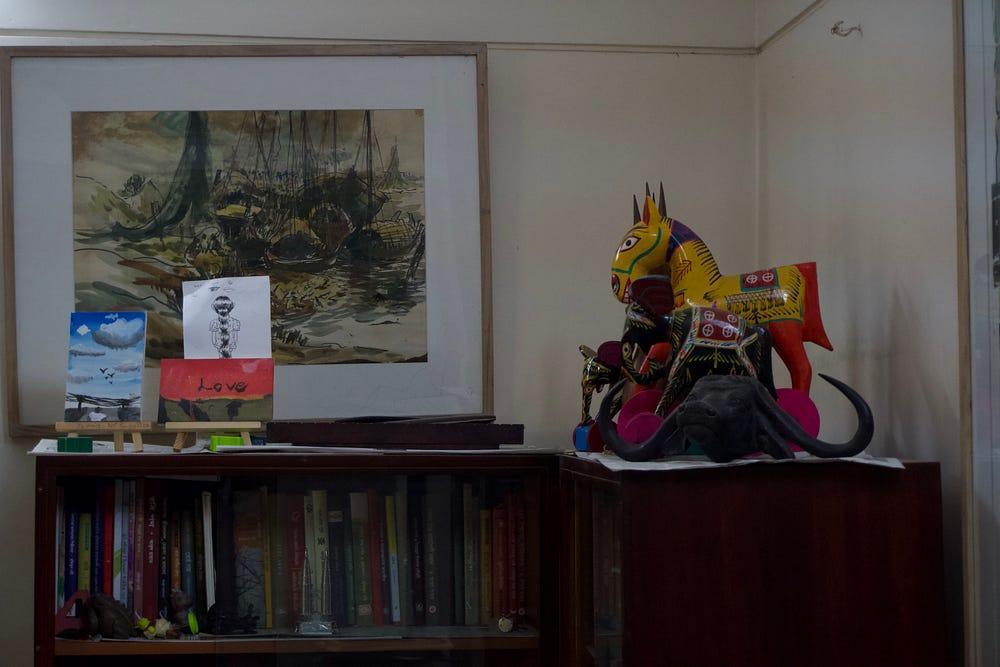
Conversation did not immediately find its rhythm; we wandered through fragments of words while our eyes stayed fixed on the paintings around the room. Frames from the 1960s surrounded us. Rafikun Nabi spoke of the years behind each one, and we listened in amazement — none of us had expected to stand this close to such historic work, or to observe it so intimately.
He shared his journey through painting — through the turbulent 1960s, through the Liberation War of 1971, and later through the anti-government movements he witnessed in Greece. He had received a fully funded scholarship to study painting there, and speaking of Greece, his stories drifted toward the days when Bangladesh had only just become an independent nation. He was among the first group of people to receive passports from the newly formed country — memories of excitement, questions at airports, and the emotional weight of carrying the identity of a nation still finding its shape.
In Greece, too, he was welcomed warmly as a guest from a newly independent country. He had gone on a government scholarship to study painting — an achievement of real prestige — but after some time, he shifted his discipline toward printmaking. It gave him a different kind of peace; he immersed himself in the process and genuinely enjoyed carving the wood itself. Woodcut demands physical labour, and age, he admitted, hasn't given him quite the same permission it once did.
Speaking of the political movements in Greece, he recalled how senior residents there jokingly told him, “You brought the revolution from your country into ours.”
But regardless of country or circumstance, he was an artist first — just as he had painted political realities in East Pakistan during the 1960s. There was pressure, of course; government pressure always existed to some degree. At times he avoided signing his own name and instead used “Ranabi.” He reflected that artistic freedom was, in some ways, broader in that era than it is today — authorities often ignored rebellious work rather than reacting to it aggressively. Exhibitions like Kalboishakhi openly displayed politically charged art, much of it under pseudonyms.
The conversation gradually turned to the changing cultural landscape of Bangladesh. He has watched the art market transform over the decades — more people now buy paintings, and art has become accessible beyond elite circles. During the East Pakistan period, he recalled, there were perhaps only twenty prominent families who regularly collected art, alongside a handful of government officers; watercolours were often painted specifically for foreigners, and outside those circles, very few people bought art at all. After independence, many of those wealthy families left for Pakistan, while a new social structure — officers, the emerging middle class — gradually built the broader art market Bangladesh has today.
At one point we asked to see Ranabi's studio. He smiled and let us explore, guided by Mishu Uncle — a thin man with a constantly smiling face, who has managed the household for thirty-seven years. That kind of longevity speaks for itself, of trust and of loyalty.
As we explored further, the astonishment only deepened. On the second floor we found his archive — work from his youth, old sketches, basement collections, woodcut prints, covers of Tokai, and even paintings by Jamini Roy from his own collection. Holding those works in our hands felt like touching fragments of history itself.
The studio on the third floor opened with shelves of books and old documents, a cartoon-style portrait hanging among them. Turning left, we found the main workspace: Winsor & Newton colours arranged carefully on the table by his granddaughter, brushes resting on nearby chairs, and a massive wooden easel standing at the centre. The floor carried stains and traces of paint built up over years of practice — almost like memories embedded into the room itself.
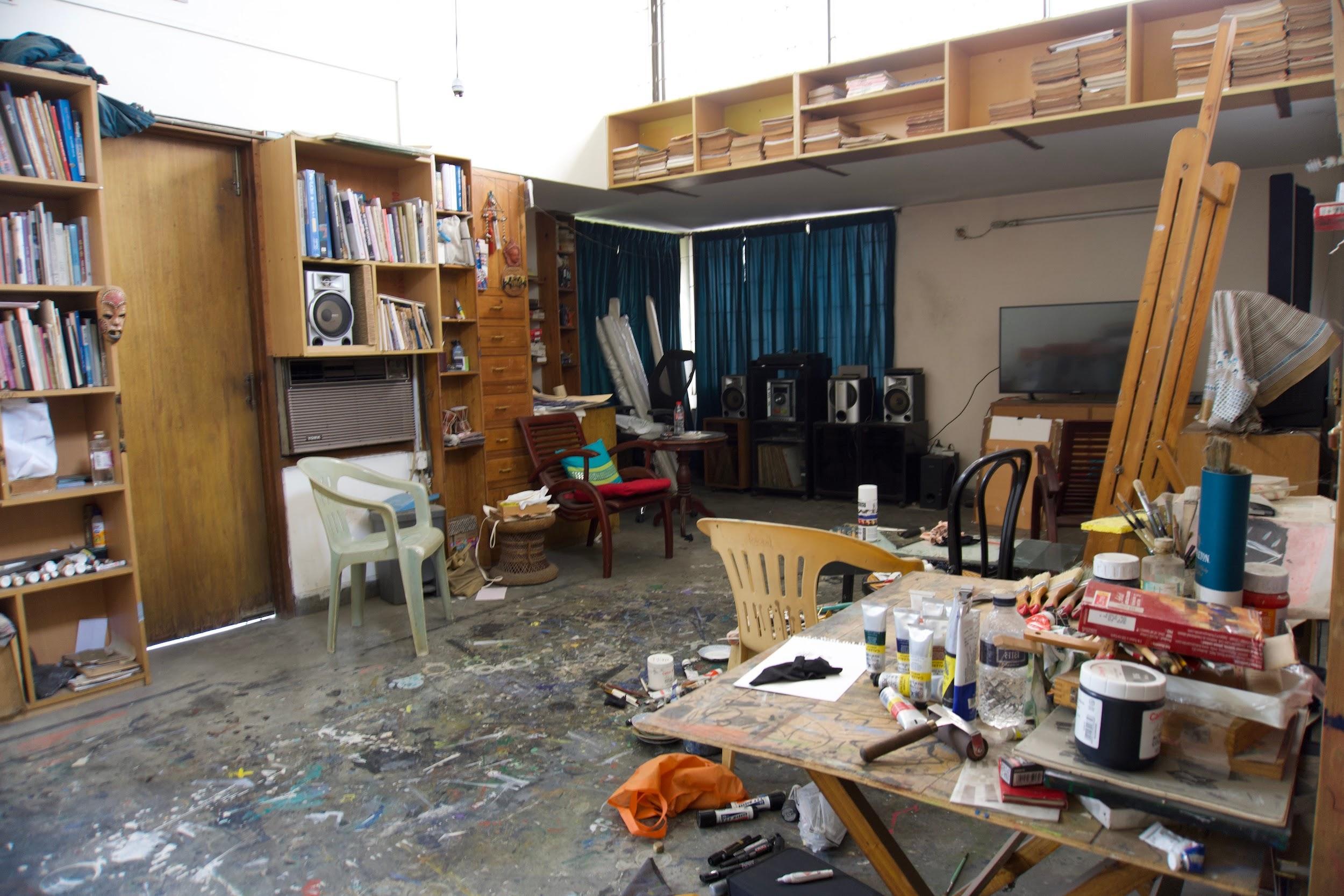
At the far end of the studio stood a music player. He had spoken downstairs about his love of music, but only here did we understand its depth — old albums, cassettes, tape recorders and records filling one side of the room. He has been attached to music since his youth, especially the classical compositions of Alauddin Khan and Rabindra Sangeet. While painting, he listens mostly to instrumental music; lyrics, he said, sometimes pull concentration away from the canvas.
He believes his children's own musical interests grew out of that same listening practice. It's hard not to mention that Ratul, bass guitarist of the band Nemesis, is his son.
Among the recent works stacked nearby, we also found drawings by his granddaughter — she paints freely, in her own way, and Rafikun Nabi carefully preserves every one of them. It was easy to imagine the scene: him painting at his easel, her drawing beside him, running around, making whatever came to mind. A quiet continuation of innocence and creativity.
Rafikun Nabi shared a story about a children's art competition once. An eight- or nine-year-old had painted something remarkably accomplished — admired by every judge — but just before handing it in, the child punched holes into the canvas to turn them into mouse holes. He spoke of that moment with real admiration. “Children are the greatest artists,” he said. “They create in their own language. When a child sits before a canvas, they already know what to paint — nobody needs to tell them.”
Even the greatest artists struggle before an empty canvas. At that moment, Ranabi recalled a line from Pablo Picasso he has always related to: “Whether the canvas is small or large, when I sit before a blank one, it feels as though I am sitting before an ocean.”
It had been a long time since we'd sat with an ocean of knowledge like that. Tea was served, and Rafikun Nabi turned to artistic practice itself — it felt like an advice session aimed as much at Rup Roy as at us. Exact imitation, he said, is not really painting; depending entirely on photographs edges toward copying, and digital colour is not natural colour. “When I paint a goat, I shouldn't see it only as a goat — I see it as a form. Painting should come from memory. Only then can form become creativity.” Too many artists skip that step now. Artists should go outdoors more, and learn to paint from lived observation and memory.
After a lifetime of work, and after saying so much through colour and brush, he still spoke with real humility about feeling lost before emptiness. Perhaps that humility is what makes him greater still.
Standing in the courtyard near the gate, it felt like waking from a dream — the trance broken the moment we stepped outside. But some trances are beautiful, and some visits deserve to linger a little longer.