A Lifetime of Practice: Mohammad Eunus
Talking with an artist often feels like talking about far more than art. Behind Mohammad Eunus, seventy-two and still filling sketchbooks, dedication outlasts everything else…
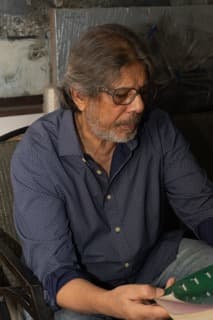
Talking with an artist often feels like talking about far more than art. Behind an artist, countless things matter — passion, circumstances, financial reality, opportunities, struggles. But perhaps what matters most is dedication: how someone continues moving toward their passion and purpose despite every challenge that stands in the way.
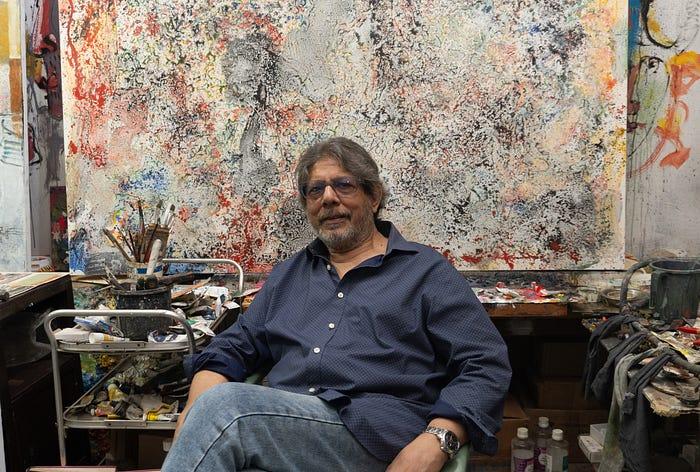
Dulonchapa Venus is now speaking of Mohammad Eunus, Chairman of Art Bangla Foundation. Everyone knows him as a renowned, respected artist. His presence itself carries authority. But very few of us truly know about the journey behind Mohammad Eunus — how much passion continues to drive him even today.
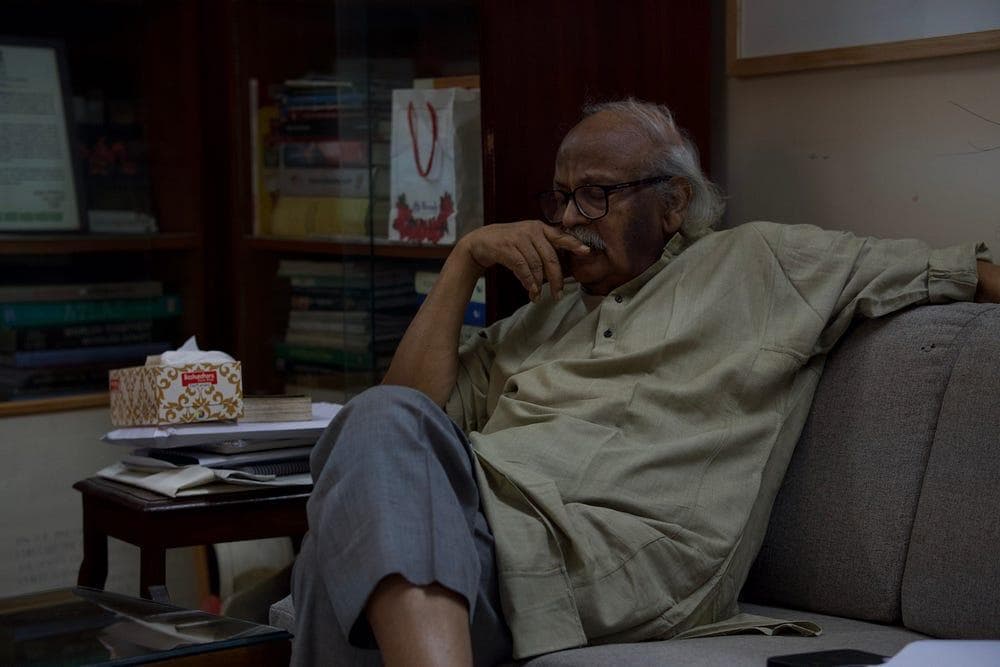
Over tea and light conversation, we found ourselves diving deeper into his artistic journey. On the table beside us lay several worn sketchbooks, and on one side, stacks of completed sketchbooks carefully tied together. His eyes paused on them as he began speaking about the journey behind those sketchbooks. If an artist does not maintain a sketchbook, the journey of growing as an artist becomes far more difficult — a sketchbook is where thoughts take shape, where ideas are groomed, where possibilities begin. Even at seventy-two, he continues this practice with unwavering discipline.
He collected sketchbooks from both Bangladesh and abroad, and it was impossible not to feel amazed. Recently, he has been working on studies of trees, exploring how many ways a single tree can be seen, interpreted, broken apart and reimagined. The versatility, the innovation, the abstract possibilities — it was mesmerizing.
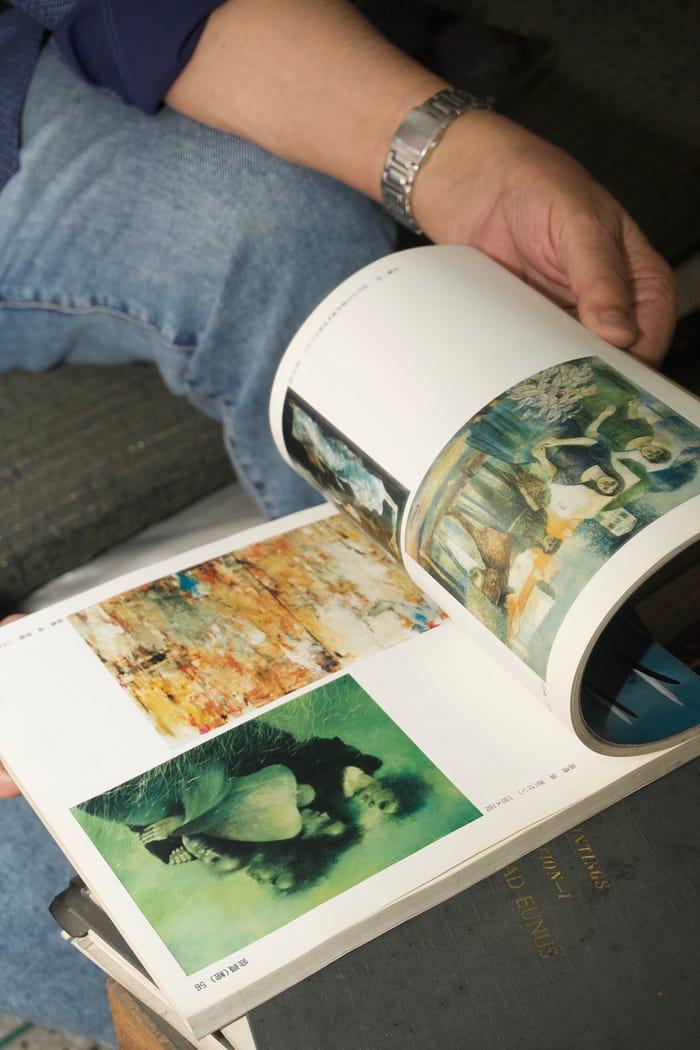
As we turned page after page of his sketchbooks, we naturally entered the world of his most beloved genre: abstract. And once you step into that world with him, curiosity becomes impossible to control. He spoke of the early 1970s, when Mohammad Kibria introduced abstraction to Bangladesh. At that time, abstraction was almost unknown here — artistic practice in Bangladesh had largely remained within traditional visual language. Eunus absorbed abstraction deeply into his own artistic identity, nurturing it until it became inseparable from his practice.
He added something unforgettable about abstract art — that it is like classical music, that it feels like poetry. It is not meant to explain everything; it offers essence, not explanation. The viewer must interpret, must feel, must enter the work. And yet, if everything in an abstract painting becomes completely understandable, perhaps it is no longer abstract — it becomes something predictable, something stereotypical.
Abstract is the pure extract of an image. Its fragrance. Its taste. Its texture. Its soul.
You may feel all of it, but you may never completely know what lies beneath — that right belongs only to the artist. That essence in abstraction is built through three elements: colour, texture and line. When these three find their perfect balance, the true essence emerges.
Listening to him, and later standing in front of his works, it became clear how deeply this knowledge lives within him. His paintings themselves stand as witnesses to decades of experience.
Do people age early when they stop working?
Though most people know him primarily as an abstract artist, very few know how beautifully he has worked in realism. To truly discover an artist from the beginning — how many of us actually take that time? His realistic works reveal another world entirely: the way he plays with light and shadow, the way he captures outdoor atmospheres on large canvases, is remarkable. And these were not small experiments — he painted outdoors on massive canvases, 48 by 72 inches, bringing landscapes or still life, light and atmosphere onto surfaces that demanded both courage and control.
Standing before those works, a quote by Pablo Picasso came to mind: “It took me four years to paint like Raphael, but a lifetime to paint like a child.” Looking at Eunus sir's painting, that quote felt strangely aligned with his journey.
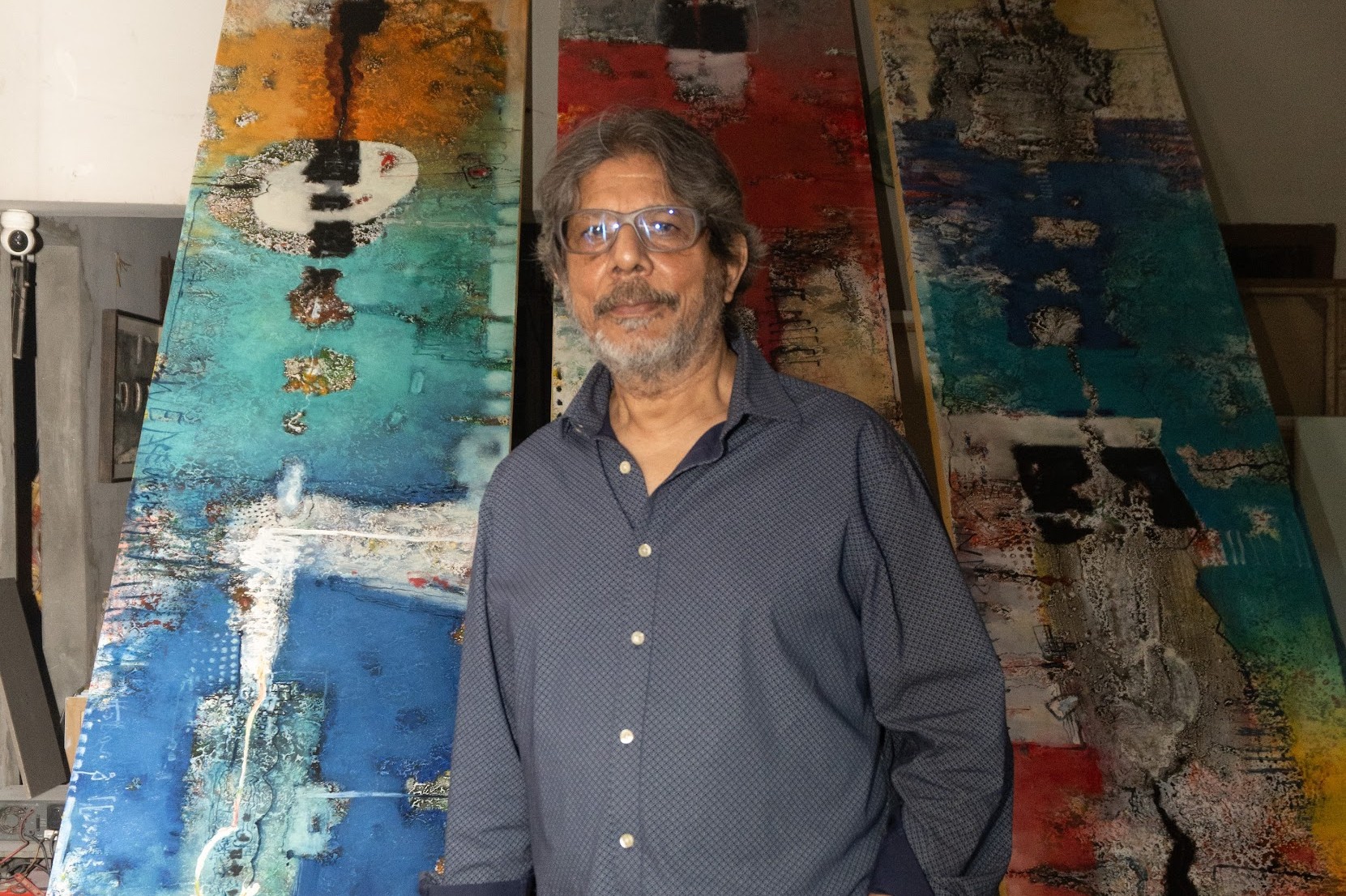
One of the most fascinating parts of the visit came when entering his studio — how he works on such a large scale of canvas. Perhaps every artist develops a comfort zone; his is scale itself. The moment we stepped inside, three enormous paintings dominated the drawing space, stretching from floor to ceiling. Even stepping far back, it was difficult to fully observe them, and those panoramic abstract paintings in particular seemed to continue beyond their own boundaries. Through another door was the room where he actively paints, and even that setup was inspiring in itself — because for an artist, the studio is more than a room. It is a place where the working mind is visible through the brush. The more organised the space, the freer the work can become.
Now, he is working on a large canvas, perhaps three by four feet. In front of him sat a massive colour palette where layers of dried paint had built up like mountains, silently testifying to years of relentless work. Nearby, shelves were neatly arranged with colours of every kind, and directly opposite stood a showcase filled with tools — not just brushes. Tools.
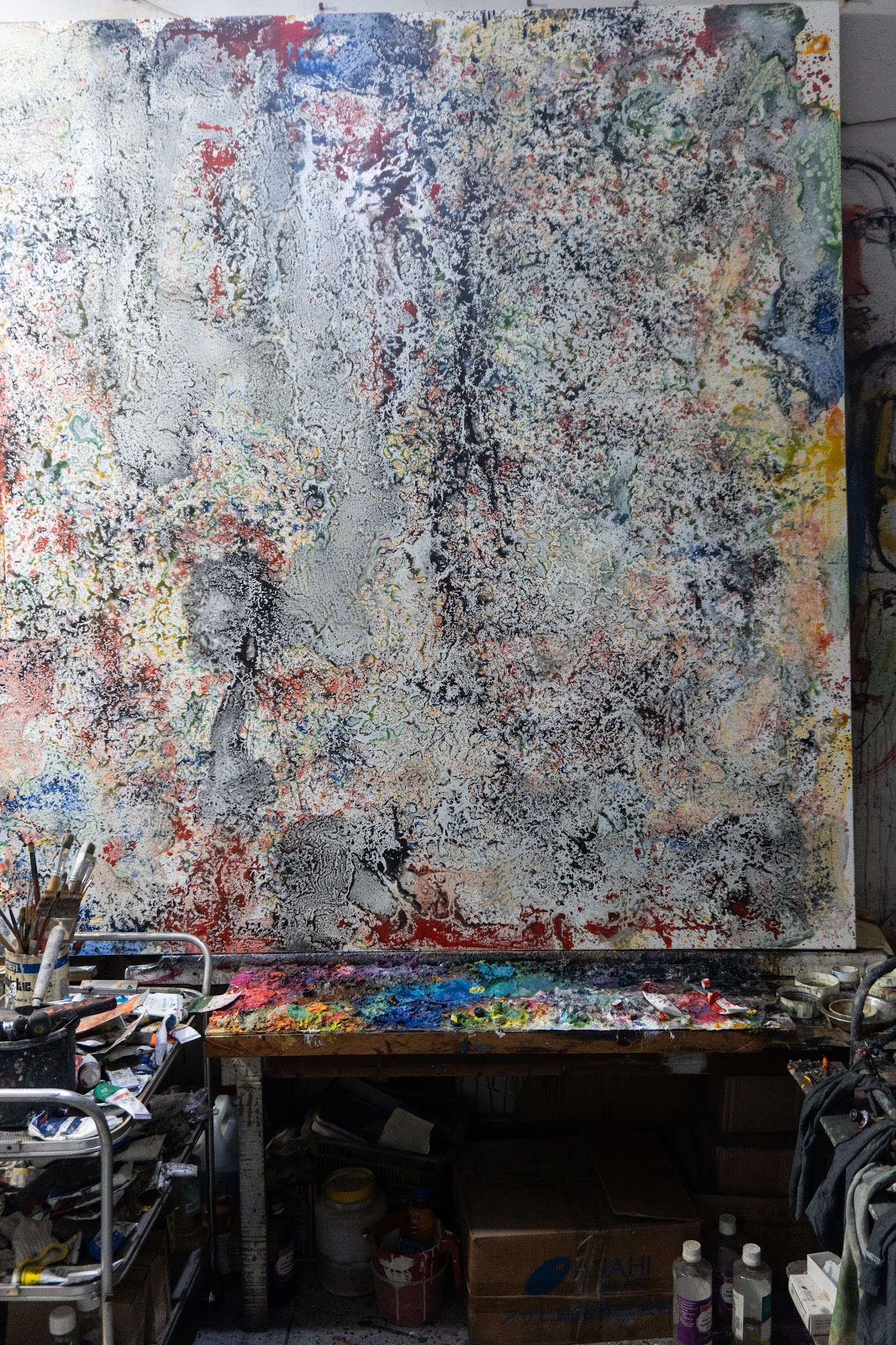
Almost every kind of hardware tool imaginable — organised, collected, preserved for artistic experimentation. He had recently brought a small hammer from abroad and showed it to us; it was so beautifully designed that it felt more like a collection piece than a tool. Holding it, one almost wanted to take it home. Beside that showcase sat a Bluetooth speaker — he works while listening to classical music alongside Rabindra Sangeet.
What a beautiful image.
He also follows a disciplined routine and regularly works in his studio. After Fajr prayer, he goes out for fresh air and a morning walk. By eight or nine, he arrives at the studio, and remains there until afternoon.
Such quiet discipline. It makes you wonder — do people age early when they stop working?
Another thrilling part of the visit was realising just how far the studio extended. His studio occupies an entire five-room apartment, overflowing with paintings. It feels less like a workplace and more like entering another universe.
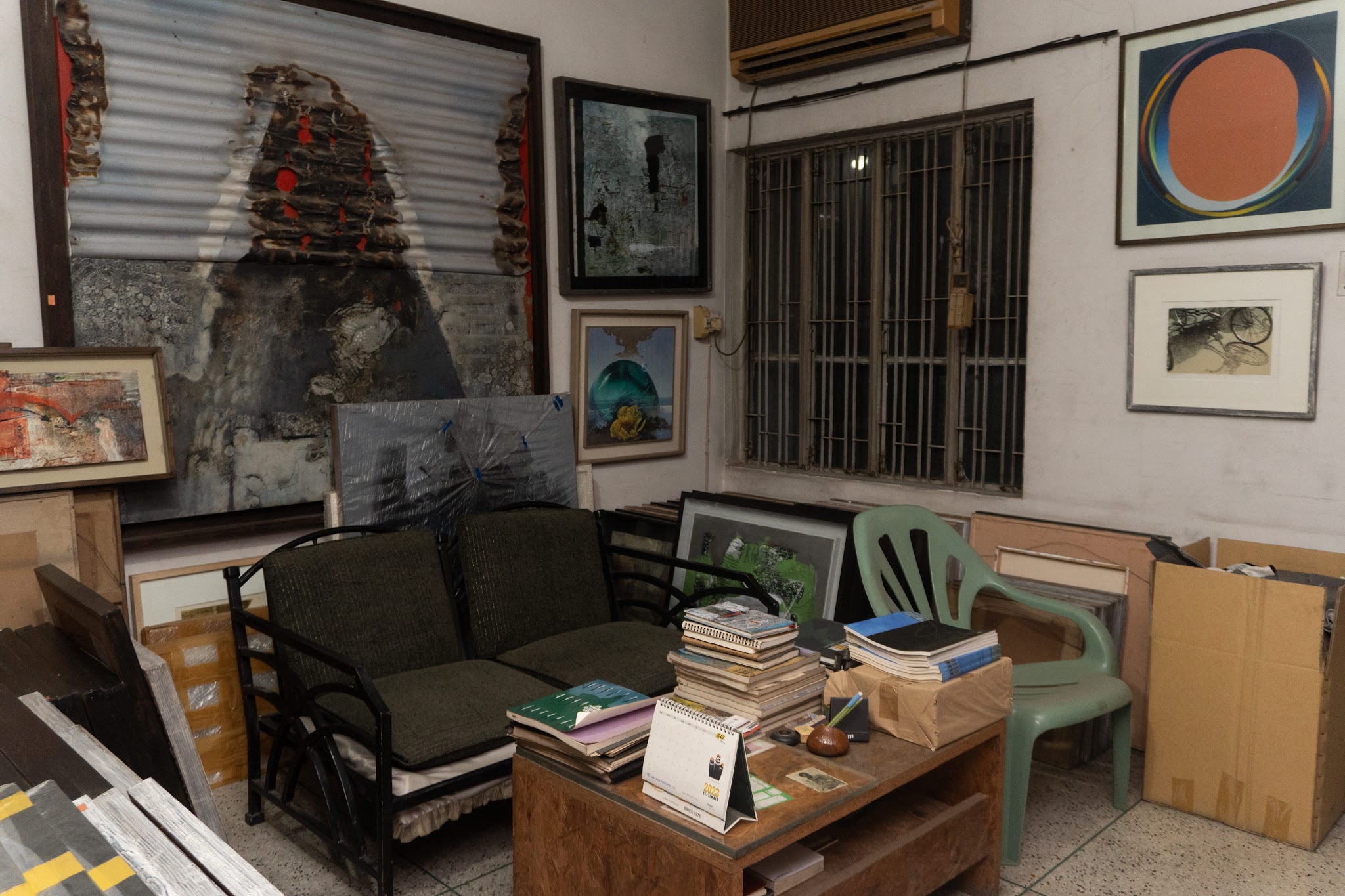
Universe or studio?
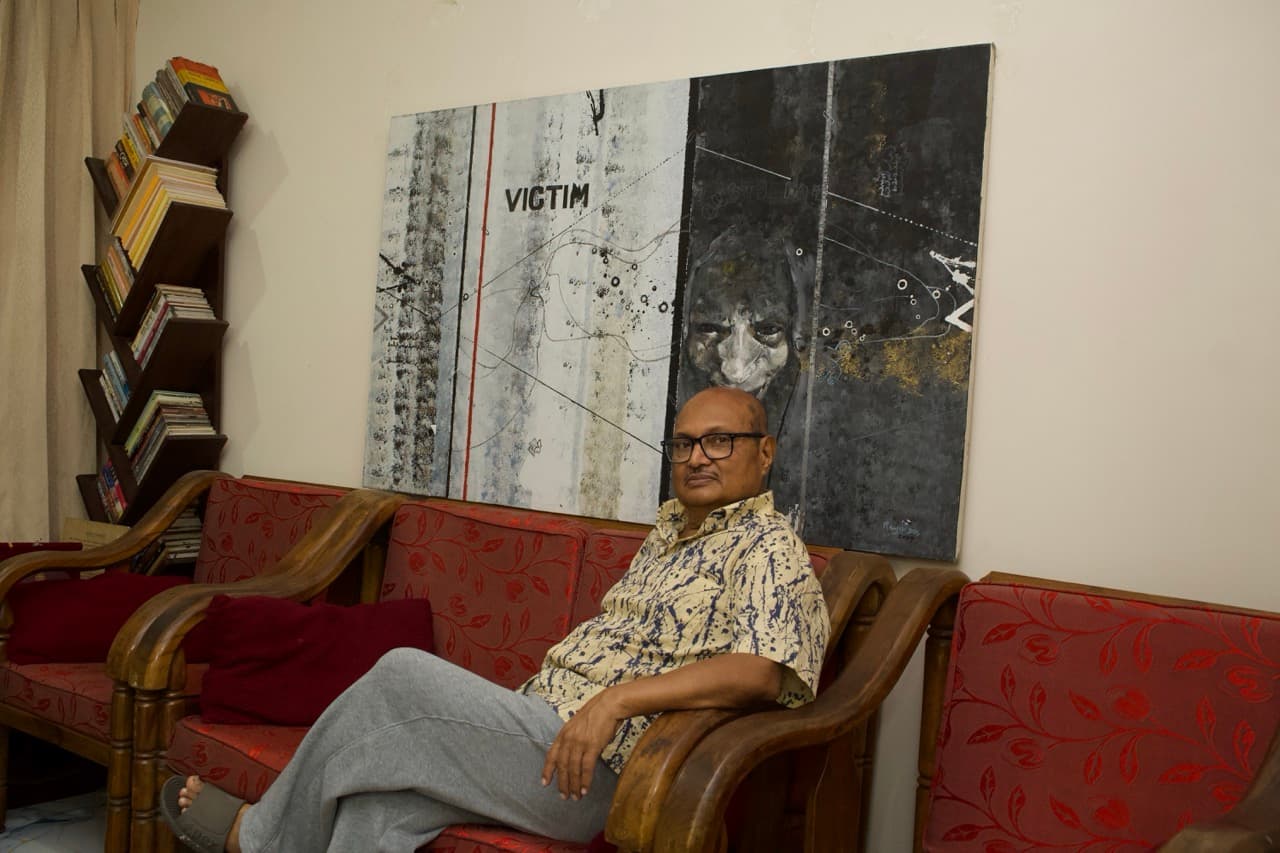
One room led to another. Then another. And another. Its boundaries kept expanding — separate rooms for paintings, archives, memories, decades of work. Without stepping inside, it would be impossible to understand the depth of what exists there. There was even a beautifully arranged sitting room, with vintage sofas, calm air, catalogues laid out on the tea table, books packed into showcases, showpieces collected over time, and Eunus sir's work surrounding everywhere. It was the kind of space you do not want to leave — the closer you get, the closer you want to become. Sitting there with his catalogue in hand, speaking with him, discussing art, was deeply mesmerising.
The only challenge came when it was time for photographs, because conversation and photography rarely flow together. Since Prithi apu was not present that day, the photoshoot continued while we explored the studio.
And one thing became impossible not to notice — he is still young. Not by age, but by mind. And perhaps that matters more than anything, because when the mind stops being young, old age can arrive at any age. That day, walking out of his studio, it felt like stepping out of a beautiful illusion — and if it was an illusion, it was a beautiful one, the kind that purifies something inside you, the kind that makes you want to become a better human being.
Even after spending so much time there, it still feels as though we saw almost nothing, as though everything is still waiting to be seen. More conversations waiting to happen. More stories waiting to be heard. More of Eunus still waiting to be discovered.