We Are Not Separate from Nature
Surovi has described her journey as shaped less by particular destinations than by an ongoing process of learning.
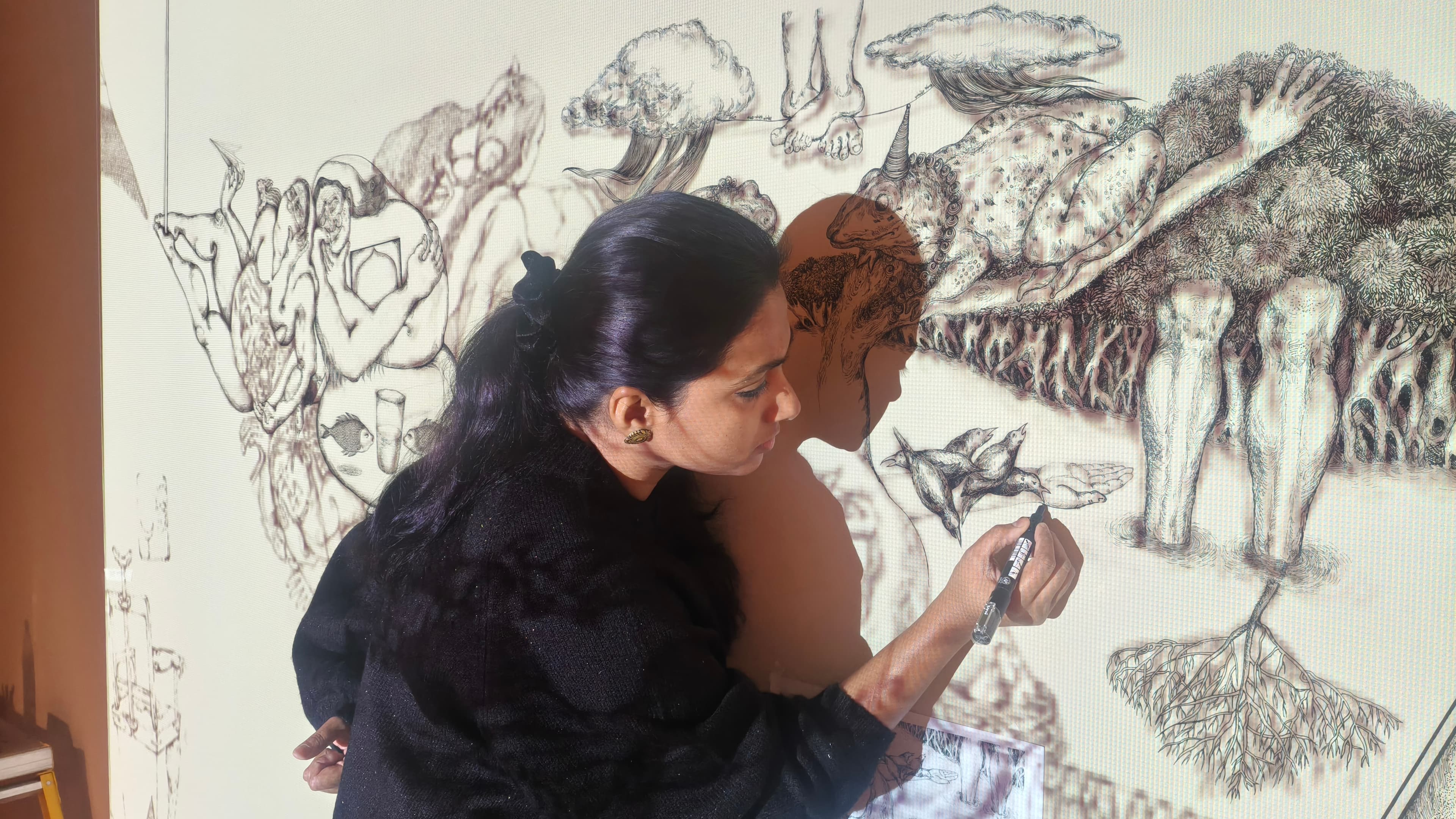
Soma Surovi Jannat's exhibition Climate Culture Care at the Ashmolean Museum presents nearly forty works inspired by the Sundarbans, bringing together themes of ecology, memory, and social vulnerability. The exhibition also reflects the journey behind these works, from her formative years at Santiniketan and the time she spent drawing across rivers and villages without a permanent studio but collaboratively working with Santhal communities. Together, these experiences shaped the thoughtful visual language that defines her practice.
At the Ashmolean Museum in Oxford, gallery 8 has quietly become something closer to a river delta. Paper, wood, ink and pigment stand in for water and silt, and across nearly forty works the Sundarbans, that vast mangrove forest shared by southern Bangladesh and West Bengal, takes shape as a living presence. This is “Climate Culture Care",the first solo exhibition of a Bangladesh-based artist in the UK , and the first solo presentation of Soma Surovi Jannat. It runs at the Museum until the first of November 2026, curated by Professor Mallica Kumbera Landrus, the Ashmolean's Keeper of Eastern Art.

The exhibition unfolds across scales that feel deliberately mismatched, in the way lived experience often is. There is “Where Every Leaf Holds a Tale", a series of eight intimate works on paper that trace the slow decline of the mangrove roots which once held the delta's storms at bay. There is “Between the Sea and the Sky, Who Holds the Ground?”, a scroll stretching almost ten metres, its length dividing plants, animals, insects and people into a single shared vulnerability. And there is “She Carries the River in Her Skin", an ephemeral drawing made directly onto the gallery walls, a piece that will not survive the exhibition's closing, built around the particular weight climate change places on women and children across South Asia. Even the smaller, quieter works, like “In A Timeless Sweet Land," drawn from childhood winters in Lalmonirhat, sit easily beside the more urgent pieces, memory and ecology never quite separable in Surovi's hands.
To understand how this body of work came together, it helps to go back further than the residency itself, back to Santiniketan, where Surovi completed her master's degree at Visva Bharati University. It was there, walking barefoot across the campus and cycling through the surrounding countryside, where she first experienced the complete freedom in learning. Long hours in nature and repeated visits to nearby Santhal villages reshaped her ways of seeing. She saw the world and paid her attention to it, a habit of looking that would come to define everything she made afterward.
When she returned to Bangladesh, she had no permanent studio, a familiar situation for many young artists there. Rather than waiting for one, she began carrying paper and pens with her everywhere, drawing under trees, inside village homes, beside rivers, wherever she found herself.Around that time, Prabhakar Barwe's “The Blank Canvas” deeply influenced her thinking, especially his reflections on creative patience. Slowly, without any conscious search for a signature style, her practice became a meeting point of observation, lived experience and instinct, and that consistency of attention gradually became the visual language now recognisable as hers.
Nature, for Surovi, has never functioned simply as subject matter. Her view is that the ecological and social crises of the present moment share a common root, forgetting that human beings are not separate from nature but are themselves part of it. Her work becomes an attempt to rebuild that severed connection through slow looking and drawing, and it is this philosophy that also guides her choice of materials, wood, handmade paper, natural surfaces, all of them chosen for the way they let a work retain touch, imperfection and care.

That thinking was more precise through the collaborations with Santhal communities in Rajshahi and Chapainawabganj, particularly with children, exploring how they understood form, colour, texture and space. She has spoken of being moved by the painted mud walls, natural pigments and alpana traditions she encountered there, art that is never separate from daily life but grows directly out of it. It is a relationship between art, memory, community and environment that continues to shape how she approaches drawing today, and it reinforced for her a belief that making art is less about producing finished objects and more about remaining deeply aware of the surrounding world, one's own inner landscape.
Surovi's decision to focus this exhibition on the Sundarbans came naturally after nearly a decade of exploring the relationship between people, nature, memory, and folklore. The Sundarbans brought all of these ideas together in one place. It is not only a unique ecological landscape but also a cultural one, shaped by generations of tradition, labour, belief, and resilience.
Her 2023 residency at the Ashmolean Museum gave her the opportunity to study the region in greater depth. During the residency, she was granted special access to the Museum's Eastern Art Study Room, where she explored a wide range of collections at the Jameel Centre. These included nineteenth-century photographs, Company paintings, Mughal and Pahari miniatures, Kalighat paintings, Bengal patachitra, botanical illustrations, maps, folk art, and colonial objects.
Rather than directly influencing her artistic style, these collections broadened her understanding of how artists from different periods have portrayed landscapes, communities, mythology, and history. Combined with her own research on Bonobibi and the Sundarbans, this exchange between the Museum's historical archive and the living realities of present-day Bangladesh became the foundation of the exhibition.
What Surovi hopes visitors take from the show is a sense that it offers more than a display of artworks, that it is instead a space for sitting with the interconnection of climate, culture and care. The Sundarbans remains one of the most significant mangrove forests on earth even as it faces mounting threats from rising seas, increasing salinity and biodiversity loss, while millions of people continue to depend on it for their livelihoods. These environmental pressures, in her view, cannot be separated from questions of history, culture and inequality, and she hopes the exhibition leaves people with a clearer sense that caring for nature is inseparable from caring for culture, history and one another.
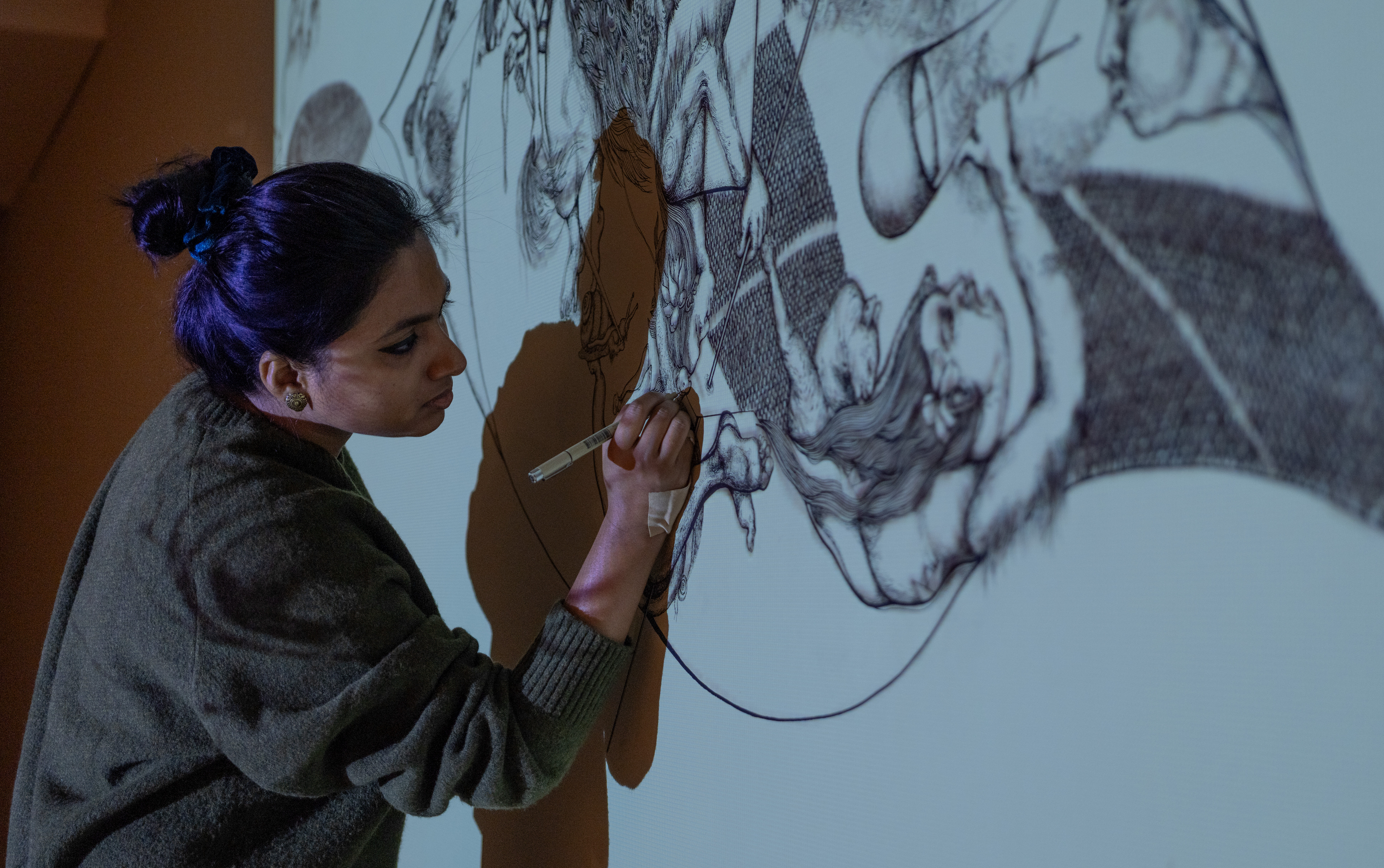
Looking back across the full arc of her practice, from Santiniketan to the villages of Rajshahi and Chapainawabganj to the Eastern Art Study Room in Oxford, Surovi has described her journey as shaped less by particular destinations than by an ongoing process of learning. The Ashmolean residency stands out to her as a milestone precisely because it drew research, museum collections, history and contemporary practice into a single space, reaffirming her belief that art making is never finished business but a lifelong exercise in observation and questioning. In conversation with Soma Surovi Jannat.